What is the Heat Transfer Pack?
The Heat Transfer Pack consists of software based on a dynamic simulator as the main teaching material, together with supplementary materials such as workbooks that help trainees better understand the course content and instructor slides developed so that instructors can teach the material clearly.
Target Processes
Hot Water Process
Trainees first gain an intuitive understanding of heat exchange between two fluids in a heat exchanger through simulator operation, and then learn the concept of the heat exchanger as a device that applies heat transfer phenomena in engineering terms, together with the relationship between the overall heat transfer coefficient, the mean temperature difference, and the heat transfer area, which are important in handling these matters from an engineering standpoint.
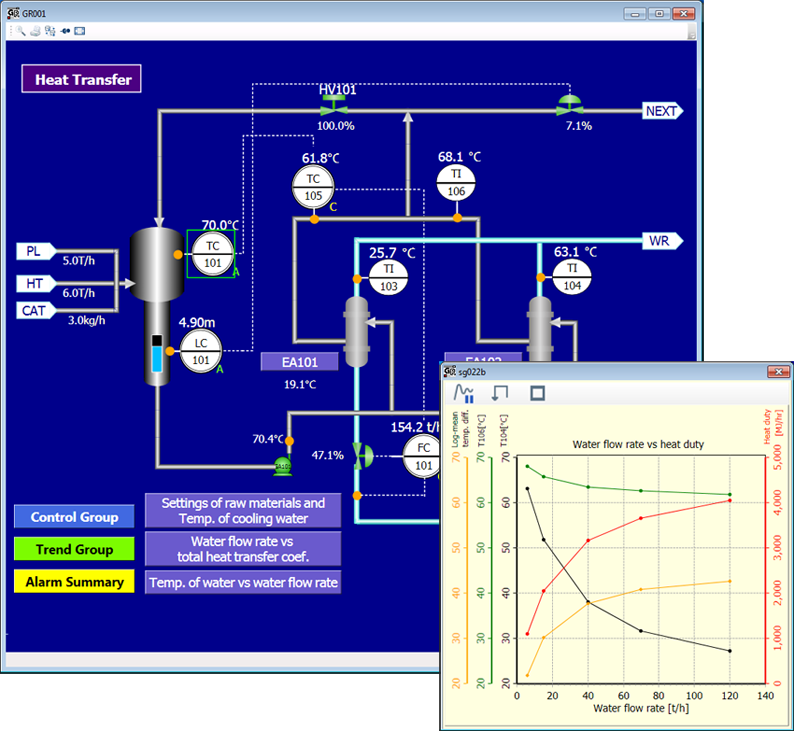
In addition, by operating the simulator and considering how to improve heat exchanger performance (heat duty), trainees experience first-hand how operating conditions affect the mean temperature difference and the overall heat transfer coefficient. As these findings are supported by theoretical explanations such as the concept of overall heat transmission, trainees deepen their understanding of the phenomena and of existing equipment, and raise their awareness of operational considerations and design in actual heat exchanger operation.
Target Users and Expected Benefits
This pack aims to help staff in production (plant operators, process engineers) deepen their understanding of heat transfer phenomena and the engineering treatment of heat exchangers. It also aims to help staff in maintenance (maintenance personnel, mechanical and instrumentation engineers) deepen their understanding of plant facilities and their operation. Target users are:
- Those who want to learn the fundamentals of heat transfer phenomena and the basic theory of heat exchangers
- Those who have experience operating actual heat exchangers and want to deepen their understanding of the effects of various operations
- Those who want to deepen their understanding of the capability and design of the heat exchangers handled at their production site